
Outdoor Dining Umbrella Guide: Sizes, Types & Buying Tips
An outdoor dining umbrella is the single accessory that decides whether your patio table gets used at noon or sits empty in the glare. It controls shade, protects guests from UV exposure, shields food from direct sun, and anchors the visual style of your dining area. Yet most buyers choose one based on color alone — then discover the canopy is too small, the base tips in a breeze, or the crank jams after one season.
This guide walks you through every decision that matters: canopy shape and diameter, market versus cantilever versus tilt mechanisms, canopy fabric, pole and rib construction, base weight, wind ratings, and long-term care. By the end, you will know exactly which outdoor dining umbrella fits your table, your climate, and your budget.
Why an Outdoor Dining Umbrella Matters More Than You Think
Direct midday sun raises surface temperatures on metal and glass tables by 20 to 30 degrees, makes seat cushions uncomfortable to touch, and creates glare that ruins conversation. A properly sized umbrella lowers the perceived temperature under the canopy by several degrees and blocks the majority of UV radiation, which matters for children, older guests, and anyone with sun sensitivity.
Shade also protects your investment. Constant UV exposure degrades cushions, fades table finishes, and warps some composite tabletops over years. If your dining area sits in full sun, pairing an umbrella with waterproof outdoor chair cushions dramatically extends how long the fabric and foam last before replacement.
Beyond function, the umbrella sets the design tone. A crisp cream canopy reads coastal; a charcoal or taupe canopy reads modern; a striped canopy reads traditional. Because the canopy is the largest single color surface in most patio dining setups, it visually coordinates everything around it — chairs, cushions, rugs, and planters.
Types of Outdoor Dining Umbrellas
There are four configurations you will encounter, and each solves a different problem. Understanding the trade-offs prevents the most common buying mistake: purchasing a market umbrella for a table that actually needs offset shade.
Market Umbrella (Center Pole)
The classic design. The pole passes through a hole in the center of the table and into a base underneath. Advantages: simple, affordable, easy to store, and it works with almost any dining table that has an umbrella hole. Disadvantages: the center pole eats table space and blocks legroom, and the canopy cannot be repositioned once the table is set. If your table lacks a hole, you would need a freestanding base, which consumes floor space.
Cantilever / Offset Umbrella
The canopy hangs from a curved or articulating arm attached to a side pole. Nothing passes through the table, so every seat has clear legroom and the table surface is fully usable. Most cantilever models rotate 360 degrees and tilt, letting you chase shade as the sun moves. This is the best choice for large tables, rectangular tables, and dining areas where guests frequently stand up and move around. The trade-off is cost and the need for a much heavier base.
Tilt Umbrella (Push-Button or Crank Tilt)
A market umbrella with a hinge that lets the canopy angle toward the sun. Push-button tilt is quick but limited to one or two positions; crank tilt (also called auto-tilt) allows smoother adjustment. Tilt umbrellas are ideal for late afternoon sun that comes in low, when a vertical canopy no longer covers the table. They remain center-pole designs, so legroom is still restricted.
Table-and-Umbrella Sets
Many buyers prefer a bundled solution. A matched outdoor table set with umbrella guarantees the pole diameter, table hole, and base are compatible and removes the guesswork. If you are furnishing a dining area from scratch, this is often the most reliable path. For smaller patios, a compact outdoor table and 2 chairs with a slim umbrella is a practical footprint.
| Type | Best For | Legroom | Shade Flexibility | Typical Price |
|---|---|---|---|---|
| Market (center pole) | Standard tables with umbrella hole | Limited by pole | Fixed position | $60–$250 |
| Tilt (push-button or crank) | Low afternoon sun, angled shade | Limited by pole | One-axis tilt | $100–$350 |
| Cantilever / offset | Large or rectangular tables, lounging | Completely clear | 360° rotation + tilt | $200–$900 |
| Table + umbrella bundle | Furnishing from scratch | Depends on set | Depends on set | $300–$1,200 |
Choosing the Right Umbrella Size for Your Table
Size is the most common source of disappointment. An undersized canopy leaves shoulders and plates in direct sun, which defeats the purpose. The working rule: the canopy diameter should be about 2 feet wider than the widest dimension of your table, so the shade overhangs the seating area on all sides.
Measure your table first, then match it to a canopy size below. All measurements are canopy diameters.
7.5 ft — Bistro & Small Tables
$60–$150Fits round tables up to 42 inches and 2 to 3 seats. Ideal for balconies and breakfast nooks. Shade coverage is intimate but sufficient when the sun is not directly overhead.
9 ft — The Standard Choice
$90–$250Fits round tables 48 to 60 inches and rectangular tables up to 6 seats. This is the most popular residential size and the easiest to find replacement canopies for.
10 ft — Six to Eight Seats
$150–$400Fits round tables 60 to 72 inches and rectangular tables seating 6 to 8. Requires a heavier base and more clearance around the table.
11 ft+ — Large Entertaining
$250–$700For long rectangular tables seating 8 or more, or for commercial-style setups. Weight and wind load become serious considerations at this size.
Height check: The bottom edge of the canopy should sit 6.5 to 7.5 feet above the ground, or roughly 1 to 2 feet above the tallest guest's head. If the pole is too short, the ribs will hit heads when guests stand. If it is too tall, the umbrella loses effectiveness at low sun angles. Most market poles are 8 feet tall, which works with standard 28 to 30 inch table heights.
If your dining table is part of a larger arrangement — for example a set with bench seating or stackable outdoor dining chairs that you move in and out — confirm the umbrella clearance before committing. Chairs with high backs need the canopy to clear them when pushed in.
Canopy Fabric and UV Protection
The canopy is the part that fails first. Fabric choice determines how many seasons you get before color fade, mildew stains, or tearing forces a replacement.
Solution-Dyed Acrylic — Best Overall
In solution-dyed acrylic, pigment is added to the fiber before it is spun, so color is locked inside rather than applied to the surface. It resists fading, mildew, and rot, and it breathes so it dries quickly. Expect 5 to 10 years of service with reasonable care. This is the fabric to choose if the umbrella will sit in full sun year-round.
Olefin — Best Value
Olefin is a polypropylene fiber that resists moisture, mildew, and fading better than polyester at a lower price than acrylic. It is slightly less soft and slightly more prone to soil staining, but for a mid-price umbrella in a moderate climate it is an excellent compromise.
Polyester — Budget Option
Polyester canopies are the most affordable and the most common in entry-level umbrellas. Without a heavy UV-resistant coating, they fade noticeably within one or two seasons. If you choose polyester, look for a stated UPF rating and plan to replace the canopy or the umbrella sooner.
UPF Ratings and What They Mean
Look for a UPF (Ultraviolet Protection Factor) rating. UPF 50+ blocks roughly 98 percent of UV radiation and is the practical target for outdoor dining. Darker colors and tighter weaves block more UV than light, loosely woven fabrics, though color choice should be driven by your design palette first.
Ventilation matters: A wind vent at the top of the canopy is not decorative. It lets hot air escape and, more importantly, allows gusts to pass through instead of lifting the umbrella. Never buy a large canopy without a vent.
Frame, Pole, and Rib Construction
A great canopy on a weak frame still fails. The frame carries the wind load, and the ribs are what snap in a gust.
Aluminum
Aluminum is lightweight, rust-resistant, and the standard for quality residential umbrellas. Powder-coated aluminum resists corrosion and holds color. Thicker wall thickness in the pole correlates directly with stability — a 1.5 inch diameter aluminum pole is noticeably more rigid than a 1.2 inch pole of the same alloy.
Steel
Steel is stronger and cheaper than aluminum but heavier and prone to rust unless powder-coated or galvanized. Steel frames are common in budget umbrellas and in cantilever models where the extra weight at the base is an advantage. Inspect welds and look for rust-resistant coatings.
Wood
Wooden poles — typically eucalyptus, ash, or acacia — deliver a warm, traditional look that pairs well with teak and other natural furniture. They require occasional oiling and are heavier to handle, but they age gracefully. Wood is less suitable for humid coastal climates unless sealed regularly.
Ribs and Hubs
Count the ribs. A 6-rib canopy is lighter and cheaper; an 8-rib canopy holds its shape better and resists wind more effectively. Fiberglass ribs flex rather than snap, which is a meaningful advantage in gusty areas. Metal ribs are stiffer but can bend permanently. The hub — the mechanism where ribs meet the pole — should be metal, not plastic, on any umbrella above entry level.
If your dining area also includes seating such as aluminum outdoor dining chairs, matching the frame finish (both powder-coated aluminum, for example) gives the space a deliberate, coordinated look rather than an assembled-from-odds-and-ends feel.
Base Weight and Stability
The base is the most underestimated component. An umbrella is essentially a sail, and the base is the only thing keeping it upright. Under-sizing the base is the number one reason umbrellas tip over and damage tables, chairs, or people.
- Market umbrella through a table: 50 to 100 pounds of base weight. A table alone is not a base — the umbrella must be weighted independently underneath, or it will lift the table in a gust.
- Freestanding market umbrella: 75 to 150 pounds, ideally a base with wheels or handles so you can move it.
- Cantilever umbrella: 150 to 300 pounds. Because the canopy hangs away from the pole, the leverage is much greater. Many manufacturers recommend filling base plates with sand or water, or bolting the plate to a deck.
Base types include:
- Plate bases — flat steel or resin plates that sit under the table. Simple and low-profile.
- Fillable bases — hollow plastic or resin shells you fill with water or sand. Cheap to ship, heavy in use, but water-filled bases can freeze and crack in cold climates.
- Cross-foot bases — four arms that distribute weight and accept paver stones. Common with market umbrellas and easy to add weight to incrementally.
- Bolted or in-ground bases — the most secure option, but permanent. Suitable for fixed dining areas.
Practical tip: If your umbrella will stand on a deck, check the load rating and use a base with a rubber or felt pad to prevent scratching. On a windy balcony, a bolted or heavily weighted base is not optional — it is the difference between a usable umbrella and a liability.
Wind Resistance and Safety
No umbrella is windproof. The goal is to buy one that tolerates normal breezes and to manage it correctly when weather turns.
What to Look For
- Wind vent at the canopy top to release gusts.
- Fiberglass ribs that flex instead of snapping.
- Reinforced stress points where ribs meet the hub and where the canopy attaches to the ribs.
- Auto-lock or pin mechanisms that hold the canopy open securely rather than relying on friction alone.
- Stated wind rating if the manufacturer provides one. Many quality umbrellas are tested to 20–30 mph.
What to Do in Bad Weather
Close and secure the umbrella — ideally with a strap or tie — when wind is forecast above roughly 20 mph, during thunderstorms, and overnight. A closed umbrella has far less wind exposure than an open one. If a storm is coming and you can remove the canopy entirely, do so; the frame and base can stay in place.
For extra peace of mind in exposed locations, anchor the umbrella base to the deck or patio surface with bolts or use an in-ground sleeve. If your dining setup includes other furniture that catches wind, such as an outdoor standing hammock or a hanging egg swing chair, establish a single routine each evening: close and strap everything that can move.
Price Ranges and What You Get
Prices below reflect current market conditions for residential outdoor dining umbrellas. Higher price correlates most strongly with canopy fabric quality, frame thickness, and base included.
| Tier | Price Range | Typical Canopy | Typical Frame | Life Expectancy |
|---|---|---|---|---|
| Budget | $60–$150 | Polyester, UPF 30–50 | Powder-coated steel or thin aluminum | 1–2 seasons |
| Mid-range | $150–$400 | Olefin or solution-dyed acrylic | Powder-coated aluminum, 8 ribs | 3–5 seasons |
| Premium | $400–$900 | Solution-dyed acrylic, vented, reinforced | Heavy aluminum or steel, fiberglass ribs, smooth crank/tilt | 5–10+ seasons |
If your table is part of a larger investment — for instance a 7-piece outdoor furniture set or a 5-piece outdoor furniture set — it makes sense to match the umbrella tier to the furniture tier. A $120 umbrella over a high-end dining set looks and performs out of place. Conversely, a premium umbrella paired with basic chairs is a reasonable upgrade if shade is your priority.
Care, Storage, and Replacement Parts
An outdoor dining umbrella is a simple machine, and a little maintenance roughly doubles its lifespan.
Routine Care
- Close and strap the umbrella when not in use.
- Clean the canopy two or three times per season with mild soap and water. Avoid bleach on acrylic; use a fabric-specific cleaner for stubborn stains.
- Let the canopy dry fully before closing for storage to prevent mildew.
- Inspect the crank, tilt mechanism, and hub for stiffness; a drop of lubricant on metal pivots keeps them smooth.
- Touch up paint chips on aluminum or steel poles immediately to prevent corrosion.
Winter and Off-Season Storage
If you live where temperatures drop below freezing, remove the canopy and store it indoors, clean and dry. Water left in fillable bases can freeze and crack the plastic. Store the frame in a dry garage or shed. If you cannot remove the canopy, at minimum close it, strap it, and consider a breathable cover — not a fully waterproof one, which traps moisture.
Replacement vs. Repair
Canopies are replaceable on most quality umbrellas, and a new canopy costs far less than a new umbrella. If the frame is sound but the fabric is faded or torn, order a replacement canopy in the same size and shape. If the crank or hub fails on a budget umbrella, replacement is usually the better economic choice.
Cushion coordination: Because the canopy shades the seating area, your cushions spend less time in direct sun and last longer. Pairing your umbrella with water-resistant outdoor cushions or a set of cushions for an outdoor sectional means both the umbrella and the cushions are working together to protect the whole seating zone.
Ready to Choose Your Outdoor Dining Umbrella?
Measure your table, decide between center-pole and cantilever, set your fabric and base budget, then compare the recommended models below.
See Recommended UmbrellasFrequently Asked Questions
What size outdoor dining umbrella do I need for a 6-seat table?
For a rectangular 6-seat dining table, choose a 9-foot to 10-foot umbrella so the canopy overhangs the seating area by at least 2 feet on each side. For a round 60-inch table, a 9-foot canopy is the standard match. As a rule, the canopy diameter should be roughly 2 feet wider than the table's widest point.
Is a cantilever umbrella better than a market umbrella?
A cantilever umbrella is better when you want unobstructed legroom and the ability to rotate or offset shade over a dining table or lounge area. A market umbrella is better when your table already has an umbrella hole and you want a simpler, more affordable, and easier-to-store solution.
How much base weight does a patio dining umbrella need?
A market umbrella through a table typically needs 50 to 100 pounds of base weight. A freestanding cantilever umbrella usually needs 150 to 300 pounds, and some manufacturers recommend bolting the base plate to the deck or filling weighted plates with sand or water for maximum stability.
What is the best fabric for an outdoor dining umbrella?
Solution-dyed acrylic is the best all-around canopy fabric because the color is locked into the fiber, giving strong fade and mildew resistance. Olefin is a more budget-friendly alternative, while polyester is the least durable and prone to fading unless it has a heavy UV-resistant coating.
Should I close my umbrella when I am not using it?
Yes. Closing and securing the umbrella when it is not in use extends the canopy life, prevents wind damage, and reduces fading. Always close it during high winds, storms, or overnight, even if the fabric is labeled weather-resistant.
Recommended Outdoor Dining Umbrellas
⚠️ AFFILIATE DISCLOSURE: This website contains affiliate links. As an affiliate Associate, we earn from qualifying purchases. If you make a purchase through these links, we may receive a small commission at no additional cost to you. Read our full affiliate policy.

JEAREY 9FT Outdoor Patio Umbrella, Market Umbrella, Beige | Outdoor Table Umbrellas with 8 Sturdy, Tilt & Crank UV Protection Waterproof for Garden, Deck, Backyard, Pool
Check price on Amazon
Blissun 9' Outdoor Patio Umbrella, Outdoor Table Umbrella, Yard Umbrella, Market Umbrella with 8 Sturdy Ribs, Push Button Tilt and Crank (Tan)
Check price on Amazon
JEAREY 9' Patio Umbrella with Solar Lights, LED Umbrella, Beige | Outdoor Table Market Umbrellas with 8 Sturdy, Tilt & Crank UV Protection Waterproof for Garden, Deck, Backyard, Pool
Check price on Amazon
Sunnyglade 9FT Patio Umbrella Outdoor Table Umbrella with Tilt Crank | 9Ft Striped Patio Umbrella with Waterproof Polyester Canopy, Aluminum Pole, Push-Button Tilt & Crank for Outdoor Patio Tables
Check price on Amazon
15ft Patio Umbrella with Base,Large Double-Sided Rectangular Umbrella,Beige | Outdoor Giant Triple Head Umbrella with Crank Handle,Market Umbrella for Poolside Garden Deck Backyard Beach Pools
Check price on Amazon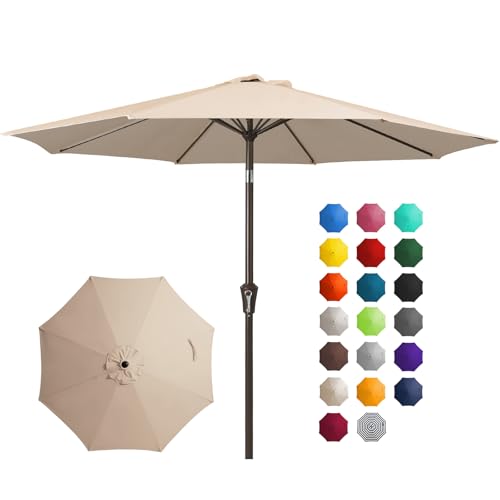
JEAREY 10FT Outdoor Patio Umbrella, Market Umbrella, Beige | Outdoor Table Umbrellas with 8 Sturdy, Tilt & Crank UV Protection Waterproof for Garden, Deck, Backyard, Pool
Check price on Amazon